Sunday, May 23, 2010

Random Photos: This ain't Seaworld; this is real-life!

We spent the weekend at a Chilean friend's beach house. We had a wonderful time (even with the chilly autumn weather). Stay tuned for pictures and words about our trip. But for now, I want to share these photos of wild sea lions we saw. It was an amazing, unexpected experience!


Tuesday, May 18, 2010

Mote con Huesillos: Chile's Drink(?), Snack(?) and/or Dessert(?)


Chile prides itself on its local cuisine. Chileans love to describe their local dishes to foreigners willing to listen. In turn, they tend to get excited whilst conducting these explanations. I have witnessed first-hand Chileans delivering applause and shouts of “mmm, que rrrrrrrrico!” during said descriptions given by others. The excitement gets to the point where it seems that they’re all going to run from the conversation to their home and immediately start concocting their prized Chilean specialties.

Because the vast majority of the native dishes involve meat sauce, meat bits, meat meat meat, Matt and I will not be partaking in much of it. Besides, after learning about their adoration of the hot dog, I am taking the locals' preferences with a grain of salt. Or, shall I say with a grain of wheat?

I’ve been meaning to try Mote con Huesillos practically since we landed. During the summer, las calles were full of street vendors offering this drink(?) snack(?) and/or dessert(?). Truth is, for a while, I had been a little scared to try it. See picture below. It’s intense, no? But after enduring the big earthquake, I felt empowered to conquer my HUGE fears, including taste-testing Mote con Huesillos.


So what is this drink(?) snack(?) and/or dessert(?), right?! Well,
mote, the little bits at the bottom of the cup, are wheat berries. Wheat berries are not commonly used or consumed in the U.S., but Matt and I have been cooking vegetarian dishes with them for a while. Their consistency is similar to brown rice, soft but a little chewy. Huesillos are dried peaches. They drop a few whole (pits included)
huesillos in every cup (the big, wrinkled floating thing in the photo above). The sugared liquid is apparently made from dried peach juice. A spoon is used to imbibe the mixture.


The verdict? This drink(?) snack(?) and/or dessert(?) is obviously very unique. Matt made the genius observation that the seemingly familiar liquid was similar to canned fruit cocktail syrup. A spoonful of wheat berries paired with the liquid did a good job of cutting the latter's cloying heaviness. My favorite part was the peaches! They were cold, somewhat rehydrated from the liquid, tender, and tasty. All in all, I was happy we tried the drink(?) snack(?) and/or dessert(?), but we won’t probably be trying it again. I can, however, confirm that Mote con Huesillos is better than hot dogs.

Saturday, May 8, 2010

Vocabulary Word of the Week: Taco

“C’mon, Christine! We know what a taco is! That’s just insulting!”

Yeah, I know, when we Americans (and Mexicans) think of a taco, we think of all that is good in the world. A taco is basically perfection. They can consist of many different kinds of ingredients but tacos always consist of delicious. Here’s an example of some tacos we often made in Mexico:


BUT, and this is the kicker, when you mention a taco in Chile, chances are the Chilean you’re talking to will have steam coming out of their ears, their blood pressure will noticeably rise, and bad words will come spewing out of their month. Like Mexico, tacos are omnipresent in Chile. But unlike Mexico, this is a taco here:


A traffic jam! It took us a while to realize this. So, like, when the newscasters would talk about "super-tacos" being all the over city, the Pavlovian response would kick in and our salivary glands would get into a tizzy, and we’d be stricken with the burning desire to hop a bus and search for these super-tacos. But alas, we realized that if we’d try to hop a bus, we wouldn’t be able to get anywhere, because we’d be stuck in a massive, unmoving traffic jam (i.e. super-taco).

Tuesday, May 4, 2010

Buenos Aires is a Million Things


We are back from a whirlwind trip to Latin America's cultural epicenter. My sore legs and blistered feet are proof that we wasted no time trying to see as much as we could. Buenos Aires is very lovable. I went into this little trip a bit skeptical, because I'm a contrarian like that. Everybody ADORES Buenos Aires, and it's the one place that people have been in South America, so I felt like it had enough affection; it didn't need mine. But the truth is, I did kind of really like it. I mean, people of all different stripes love the tourist towns of NYC and London (myself included), and this is just another one to fit into that category.

Buenos Aires is full of different neighborhoods with very different types of dwellers, distinct architecture, and varied points of interest. It’s strange, though, because last night, I asked Matt, “What was your favorite neighborhood in BsAs?” He couldn’t answer; or rather, he didn’t have an answer—and the funny thing is, neither did I. All of the neighborhoods had serious drawbacks. Of course, since time was a factor, we spent our precious few days in those parts of town that seemed to have a lot to offer for travelers in town for only a few days. That said, Palermo is too gentrified and too expat-ish. Recoleta is too rich and snooty. The microcenter is too nuts and chaotic. La Boca is too dangerous (with a section that just sickeningly touristy). Puerto Madero is too tacky and nouveau-riche (anyone want to go to Hooters?!). San Telmo seemed to be trying too hard to be the next Palermo. There were too many seemingly ignored and forgotten about inhabitants of shanty-towns.


So, what did I love about it?! Oh, I guess I loved it holistically. And of course, there were all the little things here and there. The people there seem to be very appreciative of the arts, as am I. In addition, porteños are often warm, friendly, and helpful. The Italian food is amazing; we had the most amazing homemade gnocchi at a tiny little Italian restaurant. The vegetarian options is aplenty. The Subte (short for subterraneo), their subway system, smells exactly like New York’s. There is something about that that warms my heart. There are just endless blocks of five- to eight-story walls of buildings, filled with people living life. I love that. I love city life. This is a place with a lot of city life.


Buenos Aires
is a livable place for the non-faint-of-heart. It’s loud, polluted, and busy, but at the same time, the people seem to enjoy life at an often laid-back and friendly pace. I like the contradiction. I’d be happy to be there for several months, to get to know the less tourist trodden neighborhoods and to immerse myself more into all the city has to offer, especially with regards to art. I think I'd fall in love with the place.


Okay, now for loads of pictures.


Casa Rosada (the Presidential Palace). The back of this building is where Evita delivered speeches (and more importantly, of course, where Madonna sang, "Don't Cry for Me, Argentina"):


The tile floor of the main cathedral:


Ornate house of congress:


La Boca:


Caminito (the overly-touristy part of La Boca):


Recoleta (Parisian-style, fancy pants neighborhood):


A beautiful art-nouveau grave at the very exclusive Recoleta cemetary (where Evita is buried):


In the Recoleta cemetary, as is often the case in Latin America, if you don't pay your rent, your plot is not kept up or at worst, destroyed. There are lots of abandoned, cob-webbed plots. This unkempt one is beautiful, though:


Palermo:


So, this was one of the best desserts I've ever eaten. It's called an alfajor. This type of cookie sandwich is nothing new to me (quite common in these parts) but this specific one was perfection. The two cookies are made with a lot of corn starch, making them strong, dry, and a little crumbly.. In the middle, sticking the two cookies together, is heavenly dulce de leche (caramelized evaporated milk). The d-d-l in this one seemed to contain an almond/orgeat liqueur (making it all the more scrumptious). And to finish it, this alfajor was dipped in lovely bittersweet chocolate and sprinkled with chopped almonds. It was just amazing (especially when paired with my beloved double shot of espresso):


San Telmo:


Montserrat (the neighborhood in which we stayed):

Thursday, April 29, 2010

Street Style


So, yeah, not too prolific this month on the ol’ blog. My sincerest apologies to the 100,000s of followers who spend their nights waiting by the computer, endlessly hitting the refresh button, hoping for a new entry on un peso para ti. What can I say, fans? It’s really a combined mixture of exhaustion (the mental, creative kind) and laziness.

What have I been up to this month? I’ve been realizing that Santiago is not the best city in Latin America, but, that said, this place does have its nooks of awesomeness. I’ve been snapping loads of pictures this month of cool little things here and there. Santiago grows on ya, if you put in the effort and come to terms with the fact that it’s not Buenos Aires.

Speaking of Buenos Aires, that supposed cultural capital of Latin America, well, we’re headed there in a few hours. So like, I should be excited. And I am. But I’m not bouncing off the walls excited. Traveling the globe for an extended amount of time becomes a drug. In the beginning, you’re so excited to see new things, it’s euphoric really. Then, you become addicted to seeing all these new things. And thus, after a while, seeing new things becomes so engrained in you that you kind of need to do it to survive. It doesn’t give you as much of the euphoric sensation as it used to, but you really still need to do it to feel fulfilled. It’s strange. I’ve reached a point of doneness, almost. I’m ready to see my family, MY DOG, meet my god daughter, be surrounded by the comforts of familiarity (i.e. go to Target when I need something, eat peanut butter, eat refried beans, recycle again, not see abandoned skinny street dogs everywhere, etc.), and breathe fresh(er) air.

So, am I totally dying of homesickness? Not at all. I’m just fine. I’m just feeling ready…ready to be done when it’s time to be done. That’s kind of good, I think. Though probably 18.5 seconds after being on home turf, I’ll want to start planning the next trip to places I’ve not yet traversed. That’s just the way it works.

So there, that’s some profound, inner stuff feelings-type stuff for you. The kind of thing I don’t really often share on here. But it’s the truth.

Whoa, seems I caught a case Tanget-uenza. The reason for a new post was to showcase some very awesome street art. I am a HUGE fan of public art. Some people hate it and think it’s tacky, but I love big, modern sculptures, huge beautiful murals, and colorful graffiti. Latin America’s known for its over-the-top omnipresent street art. Love it or hate it, you’re bound to see it everywhere.

There are definitely different styles to be found. One that I’ve noticed and enjoyed in a few different locations here in Chile is this very detailed style:


I’ve tried to do research on it and find out who the artists are behind it, but to no avail…yet. Here are some pictures. Go ahead and admire the skill and exactitude. Talented artists, impressive work (you'll really want/need to click on the photos to enlarge, for the full effect):


Thursday, April 15, 2010

Mendoza, Part 2: Malbec! Malbec! Malbec!


So, yeah. Mendoza. Wine country. We had some wonderful moments, but I’ll admit I wasn’t as blown away as I anticipated. I hope Argentina doesn't put me on some sort of watch list for saying it. Mendoza gets talked up big time by travelers making their way through this part of the world. What didn’t I get?! Was I missing something?!

The vineyards were the best part of the trip, but we really couldn’t afford more than a day doing that. Besides, we went on a Saturday, and stupidly enough, a lot of the vineyards are closed that day (even though we were surrounded by tons of spendthrift-y foreign travelers. Foolish of the wineries to miss out on all those potential pesos). And since Saturday and Sunday were our two full days there (and EVERYTHING is apparently closed on Sunday), we could really only spend one day doing wine tours.

The vineyards are actually in a town outside of Mendoza called Maipu. Mendoza itself was crappy. It’s a medium sized town (150,000) with the most boring architecture EVER –which is saying something in awesome Latin America (apparently all the cool stuff was wiped away by an earthquake in the 1960s). There are two good things about Mendoza. The first is the food. The province of Mendoza is full of Italians and people of Italian ancestry (instead of Spanish). Thus, there’s a ton of good homemade pasta, cheeses, and pizza (which is all good with wine!).

The second cool thing about Mendoza is the sycamore canopies lining a lot of the streets, like the one below:


Other than that, it was chock full of forgettable plaza/parks (expect for one—I’m sitting on a bench there below), low-quality crap stores, and contrived bars luring the jovenes (young peeps). Wow, I’m really talking it up, huh?


So, let’s focus on the high point: WINE! We rented bikes in Maipu to get to the vineyards. In theory, this is a romantic, beautiful way to wine-hop. And it was fun (after I had a little wine and food flowing through me). The bikes were in poor condition, the road leading to the vineyards was crazy busy with big fast-moving vehicles, and the sun was hot. In addition, the whole bike trip was an unexpected 20+ kilometers (in other words, it was a pretty hefty ride).

Wow, I keep reverting to negative! Seriously, let’s get to the good stuff, right?!

Okay, so our first stop was at San Felipe. San Felipe is a big, mass-producing winery. The cool thing about visiting this place was that they give free and very comprehensive tours of their facilities, which includes loads of wine-making artifacts of the 19th century.

At the end of the tour, we tasted a Cabernet that they sell only to people visiting the winery. It was not good. So obviously sellable only with gimmick attached (get it while you're here!). The tour was very interesting, though.

Hectares and hectares of vine canopy. So beautiful:


Dehydrated, spongy grape refuse, fresh off the conveyor belt. It smelled really good.


The next winery we visited was Carinae. This is a very cute small-scale winery run by French expats. Again, we got a tour. It was cool to contrast their facilities with the ones from San Felipe. At the end of the tour, we could buy a couple tastings for a very good price. I enjoyed all the wines we tried there, especially a smooth, earthy, buttery Cab-Malbec blend that was only available for purchase at the winery (not gimmicky in this case, but expensive). At the end, we walked away with a Malbec Rose and a Torrontes (Torrontes is a white wine that is a kind of an Argentinean specialty). This was a fun tasting, because in addition to the truly lovely wines, they served an amazing crusty baguette and a house-made olive oil. Carinae was a definite highlight.

The olive trees were gorgeous, though be forewarned; unripe raw olives taste horrific. Tried and true! Please, please take my word for it!


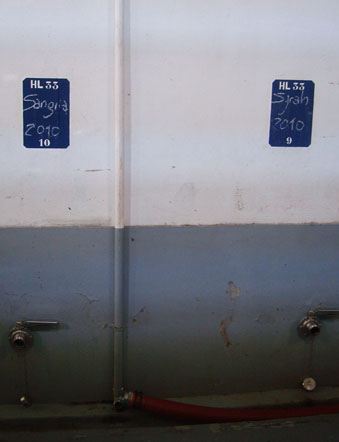
The oak barrels smell so good. They cost the winery $900 apiece and are sold after only one use (for the best wine--el gran reservo)


Carinae's beautiful facilities:


We like to pretend that we know what we're doing:


Side note: We happened to do the Carinae tasting with a loquacious UT undergrad who is studying in Buenos Aires but was visiting Mendoza for the weekend. Hook 'em! (or something).

After that, we had lunch at Tommaso. This is the oldest winery in Mendoza (a couple hundred years old). It was a cute, unassuming place (with vegetarian options on the menu!). Matt had amazing spinach and four cheese canelones, and I enjoyed a lovely corn and red pepper pie. We polished off a bottle of their Torrontes with this meal (it paired especially well with Matt’s dish).

We devoured fresh, lovely olive oil and delectable bread all weekend:


Matt's plate:


Mine:


The wine:


So, there you go. Would I have gone, knowing what I know now? That's a definite maybe. It was cool to experience and be surrounded by a world-famous wine country. But, would I do things differently, knowing what I know now? Definitely. If you venture out this way, don’t go to Mendoza on the weekend. And my advice to myself: don’t go thinking that just because other people love it, that means it's going to be the most amazing place EVER. That does not oft work well, those pesky great expectations. Lesson learned.

Tuesday, April 13, 2010

Mendoza, Part 1: Hair-pinning through the Andes


Finally, FINALLY I have something blogworthy to add to the blogosphere, thus avoiding blogageddon, or at least avoiding unpesoparati's blogmise. Ugh, don't know if you have noticed, but blog-blended words are the new fusion trend. Ugh.

ANYWAY, so yeah. It's time to dust off this here creeky ol' blog, and get back to business. I had four weeks of an extremely difficult Spanish class, and by golly, that's finally behind me (though I do hope the I gleaned a bit of knowledge from it).

We went to Mendoza, Argentina, this past weekend. Mendoza is where 70% of Argentina's wine is produced. To get there, we hopped El Rapido, a double decker bus for an eight-hour ride through the Andes.


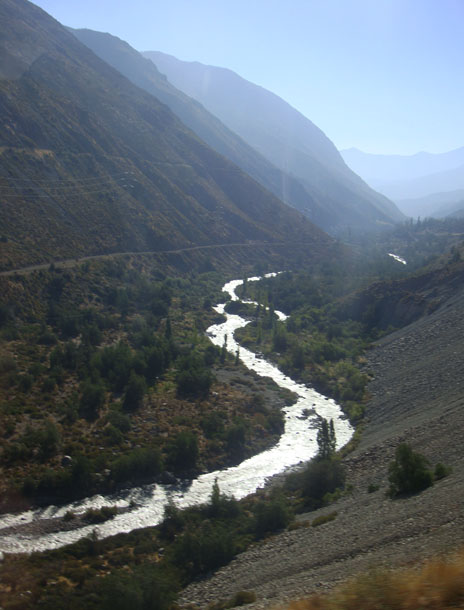
The bus ride through these amazing steeps and slopes was incredible--definitely one of the best parts of the trip. There were a lot of curvy rivers running down the mountains. And the long and windy road followed alongside them for countless miles:


On the Chilean side, there were loads of little footbridges from the highway, across the river, and to the houses on the other side:


The following is another one of those pictures to scare my mom. Click on this baby to enlarge. On the way to the Chile/Argentina border, there was first a very steep mountain to climb. CHECK OUT THESE SWITCHBACKS! Yes, they were scary when the driver took them a little hot. But alas, we're still here.


Above these switchbacks actually ran a ski lift (an unbelievably steep ski lift--over the highway!) for those extreme skiier types (not skiing season just yet).


Both times that we reached the border, we had to go through customs and immigration. That meant getting out of the bus, having our passports stamped, and sending our luggage through security. A pain, of course, but the price to pay for views like this:


There were a lot more craggy rock formations on the Argentina side. It's a desert climate, even in Mendoza:


And lastly, just to scare my mom again, is a picture I snapped going down those crazy switchbacks seen above.


Expect more about Mendoza tomorrow. Back-to-back posts; aren't you lucky?!